Saturday, October 10, 2015

WCLAC: Same vision, different backgrounds

Meet the new team of volunteers working at WCLAC for the next 10 weeks...

Charlotte:

After graduating from university in 2013 and having spent the past year and a half volunteering with the Citizens Advice Bureau and working in a law firm, I needed a change. I've wanted to work with underrepresented people for quite some time and this is the main goal I am hoping to achieve during my placement with WCLAC. I'm passionate about women's rights and am really looking forward to working with some truly inspirational people at the Women's centre in their campaign to bring about change for women in the oPt.

We arrived almost three weeks ago and met our in-country counterparts at the training session the following day. We were introduced to day to day life here in the oPt and what we were hoping to achieve within our projects. The muslim holiday Eid al-Adha began the day after training and we were able to enjoy some of the festivities. The in-country volunteers brought in some traditional Eid sweets called ka'ak bi ma'moul for us to try which were delicious!

Azeldin:

I volunteered with ICS because I want to make a difference in my community and myself but I lack the tools and methods to achieve it and that’s what I hope ICS will do for me.

Eid is an arabic word that means holiday or festival, muslims have two major Eids ( Eid al-Ftir & Eid al-Adha). Two weeks ago it was Eid al-Adha which means the Festival of Sacrifice, during this holiday we wake up early and go to pray in the mosque, in our case we went to the Aqsa mosque. Praying is more beautiful during Eid because a lot of people will come from all over Palestine to pray in this mosque and most people are happy and wearing new clothes. After prayer we start saying “ALLAH AKBAR…” with each other, thousands in this case. After this spiritual experience we go home and those who are considered quite wealthy will sacrifice a goat or a sheep and distribute some of it to the poor. My family and I went to visit our sisters, aunts and of course the children, who in my eyes enjoy this holiday the most, and we gave them money (edya). The children play all day long and get money from their relatives so they can then buy a lot of new toys and spend Eid playing cops and robbers with their cousins and friends.

Eid is a time to remember your family especially the women if you had forgot about them, and also to remember the poor and those who are in need. It is also a time to remember Abraham and his faith and sacrifice. I think if they want to change the name of the holiday they should name it Holiday of Remembrance.

Ala’:

Helping people was always something I looked for, I tried several ways and when I heard about ICS I thought it would be a good opportunity. Besides, volunteering provides new experiences, friendships, and it develops both your character and community.

WCLAC was established to help women who are abused or are suffering due to domestic violence. They also aim to raise awareness among women of their rights. We are volunteering to help this centre in several areas such as: translating and proofreading documents and case studies, hosting workshops, developing proposals for fundraising and other tasks. We will be helping the main centre as well as some of its branches and grass-roots organisations supported by WCLAC.

Aoife:

Having volunteered at several Legal Aid centres back home in the UK, I was particularly inspired by the work that WCLAC does for Women in Palestine and the issues that they face on a daily basis. Since arriving, we have heard lots of inspirational stories from women living in the oPT speaking out about their horrific experiences in order to try and change attitudes towards gender-based violence.

Over the next few weeks we are planning to facilitate a number of outreach workshops for groups of men and women. The purpose of these workshops is to raise awareness of gender-based violence and to help break the silence on domestic abuse by encouraging people to speak more openly about it. This week we had planned to meet grassroots partner-organisations. Unfortunately, it has been harder to travel currently so we have not gone to visit yet. We have decided to use this time wisely by researching crowdfunding platforms in order to raise money for extra beds at WCLAC’s emergency protection shelter.

We’re excited to get stuck into the project and see how we can support the vital work of the centre.


Thursday, October 8, 2015

PFU: Getting started!

In the first week we had training where we got to meet all of the in-country volunteers, they’re great, we had lots of fun team activities and tasty food! The day after training was Eid al-Adha so we got to explore Ramallah a little bit and get to know all of the UK volunteers much better! We also got brought some traditional Eid sweets by the in-country volunteers, they were delicious! Ramallah itself is a great place to visit, there are lots of places to eat and lots of nice coffee shops, but we all loved the market the most, with its many fruit and vegetables stores, where you can see bread being made fresh,and smell the wonderful spices coming from the spice stores as you walk by, and pop into small stores to eat fresh knafeh and Baklava.

On our first Sunday off we went to visit Jericho with both the in-country and UK volunteers, it was very hot! We got to see the mount of temptation and talk to some really interesting locals and we brought drinks to cool us down from the heat.

Some of the volunteers enjoying a language lesson!
The first week of work at PFU has been really productive. Abbas is really enthusiastic about the projects that are currently running, he has a coffee meeting with us every morning to discuss the last day’s tasks and assign new ones. We are currently doing proposals for funding and policy briefing, these are really important to help further the good work that PFU do! All the volunteers are great! We love having conversations about culture and traditions. The in-country volunteers have been giving us language lessons at the end of each day which are really helpful!


We also enjoy guided learning sessions together where we discuss a variety of topics that are important to us. I’m really looking forwards to seeing the project develop over the next few months and expanding my skills!

In the first week, and as an in-country volunteer, we got the chance to meet all of the UK volunteers and all leaders of the teams. The training that included all of the in-country and the UK volunteers was exciting and fun. The UK volunteers are nice, we did a lot of activities to break the ice. In some activities we were able to understand a little about each other’s cultures, these activities in particular were very interesting. During the last day of training we got to know the volunteers and the project we will be working on better which is the PFU. I think our project is very interesting as we get to know more about the issues facing the agricultural sector in palestine,farmers’ rights and some of their stories through field visits. After Eid Al-Adha we met Abbas at the PFU, he gave us a general idea on what they do, about the agriculture in palestine, and what we will be doing during our placement.

The first week at the PFU was all about planning our work and finding what interests each and everyone of us to distribute the assignments between us. We work mostly in pairs or all together which is more fun and productive.

It has been harder to travel around currently, so we haven’t had the chance to go on field visits yet nor to the olive picking that we were planning to do, but hopefully we’ll be able to in the upcoming weeks.

The Arabic lessons we have at the end of every day are fun and we can see how excited and enthusiastic the UK volunteers are in terms of learning new words . Each day we teach the UK volunteers ten arabic words that they want to learn and they teach us some of the English words used around the UK with different accents.


Ruth and Sawsan

Thursday, August 13, 2015

PFU: Coming to a Close

When I first mentioned to my mother, just over a year ago, that I had a vague idea about spending my summer in the Palestinian Territories, she brushed it aside thinking that it was merely another of my ‘airy fairy ideas’. Fast forward a year to me packing my suitcase; to say that she was not keen on the idea is an understatement. Notions of euro-centricity, coupled with highly orientalist media reporting that portrays the Palestinian Territories as a barbaric, uncivilised place full of terrorists resulted in one teary mother convinced that I was going to be spending my summer in a war zone. 

The time that I have spent in the Palestinian Territories has, however, consistently proven that such notions are merely fictitious. For the most part, the people I have encountered have been friendly and welcoming, keen to provide insights into the culture and history of their home. Palestine is, however, of course a complicated place, even referring to where I have been living for the past 3 months as Palestine has been contentious at times. However, occupation, which is now synonymous with Palestine, doesn’t define it. That is not to dismiss its reality and impact as it permeates every aspect of life; from the high cost of living due to the dual taxes that Palestinian businesses encounter to the unfortunate reality of friends not being able to attend day trips due to travel restrictions. It is just to state that contrary to widespread news reporting, Palestine is so much more than simply checkpoints, roadblocks and intifada

Last week, myself and some of the other volunteers stumbled across a business 'expo' at the Movenpick Hotel in Ramallah. Over 50 companies, cooperatives and communities came together to show case their products, brands and businesses. It was great to talk to people from across the Palestinian Territories and provided a refreshing change to the occupation discourse, which dominates conversation here. It further cemented that, to me, my favourite part of my placement has been when I have been engaging with Palestinians, whether at the marker or during my first week when myself and the in-country volunteers compared episodes of X Factor and Arab Idol as part of a ‘cultural exchange’. 


Thus it is rather bitter sweet to be writing this blog post, knowing that it will be one of the last from this cohort of ICS volunteers but at the same time I'm feeling a sense of excitement to be going home and seeing what lies ahead, especially considering the skills that ICS has enabled me to develop. It is hard to summarise my placement in only a few words but, if I had to, I would say insightful, productive, at times challenging and frustrating but overall a highly recommended experience. 

Wednesday, August 12, 2015

WCLAC - A New Perspective Towards the World

Being a young woman in Palestine, I was set on achieving specific goals. One of them was to become independent, and the second one was to break free of all the strings that attach me to the wrong perception of a woman’s value in her community. Women are perceived as intellectually inferior in the OPTs or to be treated in a confined manner, kept isolated and allowed only to perform specific tasks as assigned by the male figure.

Through ICS, and the workshops we have held around Palestine, I have developed my interest in the problems facing women daily in my community.  I have read and listened to many stories of women during their periods of suffering. Their strength, resistance, and ability to survive violence against them is the result of the seed of a fighter that grows inside each Palestinian women, which is nourished by everything that they go through. Growing up powerless and subjugated to men means that women here have had to fight fiercely against common negative perceptions.


Their strength, which develops them from being powerless into strong hard working women, who earn their money with their bare hands, is what encouraged me to search deeper into the source of their strength. ICS assisted me in taking my first steps towards what I want as a woman. I want to open more doors for young women to find their light of hope and purify them from all the pain. My voluntary placement has had helped me not only focus on the issues I face individually, but opened my eyes to the issues faced by my gender as a whole. This has ignited the flame within me to fight for a change for women.

 During my journey with ICS I have made lots of Palestinian and British friends. We have done many things together, including iftar in Ramadan. I was really touched by how supportive and respectful some of the British volunteers were when some of them fasted with us, whilst many others did not eat or drink in front of us. My summer was fantastic and vastly different from previous ones as a result of them being here.  We went out together many times for lunch, ate ice cream from Baladna and went shopping.

Seeing Palestine through their British eyes was fascinating. They were really happy watching a bunch of kids dancing in the street, or getting excited seeing a wild cat walking by or how they could walk around valuing every stone of my home. From our conversations with our British counterparts I realized that Palestinians are strong human beings and I am proud to be Palestinian. We held on to every inch of land available, and sacrificed our lives in order to protect our soil. Throughout this project, I also came to see how precious and beautiful my land is. It is the land of Palestinians, the land of strong women and the land of fighters.

I would like to thank the ICS program for granting me such an enlightening experience and increasing my awareness of social problems within my community and how to tackle them. ICS has highlighted the significance and importance of bending down and offering a hand to the ones who need our help most.


Monday, August 3, 2015

PFU: Volunteering with ICS

By Barakat Azar

I am really glad to have joined the ICS program, which has given me an opportunity to get to know other cultures and learn new ways of life from different people. I have enjoyed this opportunity, especially because one of my interests is to know about other cultures and explore them in depth. I am not afraid of seeking the unknown and facing new adventures. Also, I know that the human experience is different and versatile, it is not based on one colour and all of those experiences enable the human being to explore the meaning of life. This is why I was encouraged to do my duties as a volunteer.

My specialty in the placement is with journalism and media. I have worked with the Palestinian Farmers’ Union on a number of things. One of those things was producing and editing a film in Arabic about the three million trees campaign. I also commenced working on the English version of the three million trees film. This campaign was implemented by the Union, which aims to cultivate tens of thousands of fruit trees and support the steadfastness of farmers, especially in areas threatened by confiscation by the Israeli occupation.


I also started working on the design of a newsletter for the Union. I used computer software to create the design from scratch. The newsletter will cover the past four months and will mention the implementation of many projects, courses and other events and activities carried out by the Union in partnership with several local and international institutions.


We also visited the Tent of Nations in Bethlehem, which is an organic educational farm. This was a wonderful story of steadfastness that enabled me to understand what is going on behind the scenes. It showed me how Palestinian farmers stand alone in the face of the Israeli occupation and how farmers try as much as possible to preserve the land of their ancestors. I found it interesting to learn that the Israeli security forces may still confiscate land, even if you have registered your land.


Saturday, August 1, 2015

PFU

We’re now well underway in our ICS placements here in Palestine – and what an incredibly sobering experience it’s been.

Upon mention of ‘Palestine’ you could be forgiven for instinctively conjuring images of unrelenting violence and misery inflicted on an indigenous people. Whilst this may often be the case, it’s not an entirely accurate assessment of life in the occupied territories. The Israeli occupation is seen rather than spoken about; its presence permeates ordinary life like the tear gas that lingers thick in the air, burning slowly as opposed to igniting furiously. So, despite this endless nightmare, Palestinians have adjusted and found normality in the madness; a beautiful nightmare.


The dream begins every dawn with the soothing melodic sounds of the call to prayer as the Ramadan fast begins against the backdrop of a stunning sunrise. It’s here the day starts for the majority of Palestinians, although fortunately for my colleagues and I, we’re afforded a few more hours before our placement at the Palestinian Farmers Union (PFU) begins. Having spent the first weeks acquainting ourselves with the organisation and its objectives, we now feel comfortable in engaging with the challenging tasks that lay ahead. In a concerted effort with our local Palestinian volunteers, we’ve undertaken various roles and projects that range from continuing the efforts of previous cohorts to pursuing uncharted territory in the field of agriculture, the beating-heart of the Palestinian economy. These range from social media management, providing a local and international platform seeking to highlight the plight of farmers, to drafting extensive funding applications to finance projects designed to alleviate the harsh conditions the occupation imposes on the agricultural sector. It can be as daunting as it sounds, and the obstacles – from bureaucracy to the physical impediments the occupation imposes – can often be disheartening. Yet, appreciating the significance of our efforts, and a yearning for some justice, keeps spirits high and minds focused.

Outside the office, there’s an infinite wealth of mesmerising beauty, history and culture that promises to occupy (no pun intended) the wanderer for days on end. I began this journey in the Old City of Jerusalem, a place that truly encapsulates the senses, and quite frankly defies all description.


A melting-pot of thousands of years of monotheistic civilisation stands proud and inviting. Bustling markets proffering the wildest fruits and artistic designs jostling for your attention, intoxicating scents of spices and perfume and cobbled pathways brimming with frenzy. But, perhaps most captivating of all: the simultaneous fusion of the call to prayer from the besieged al-Aqsa mosque, the sounds of synagogue klaxons reverberating across narrow tunnels and the ringing of the church bells, threatening to overwhelm. It’s blindingly clear to see why they call this the Promised Land.  

Wednesday, July 29, 2015

WCLAC - One Month In

It has been more than a month since we’ve touched down in Palestine. The most astonishing thing so far has been seeing the unity that people display despite the obvious conflict. Meeting numerous Palestinians has altered my perspective completely from the image that the Western media portray. The common misconception of the Occupied Palestinian Territories being immersed in terrorism and violence is not at all what I’ve experienced. This is not suggesting that it does not transpire, I am merely stating that within many parts of the Occupied Territories most citizens live in peace and unity.

It is evident how nice people are, especially during Ramadan. We have been invited to countless iftars where we got to eat traditional Palestinian food, including Maklouba, Qatayef and of course Knafeh. As this is the first time for me being abroad without family during Ramadan, it was nice to break my fast with home food and company. During this holy month I was also extremely blessed to have the opportunity to pray at Al-Aqsa Mosque and The Dome of Rock. Some Palestinians haven’t visited in over 20 years as their permits have been rejected countless times. This was so harrowing to hear, especially as I know how important it is to some Muslims to pray in the compound.

The Occupation does not only affect the rights of Muslims and Christians to pray, but also women in general, and this is combined with cultural idiosyncrasies of Palestine. Women face constant discrimination and working in WCLAC has made me realise how difficult it can be to live in a society where men are seen to be the ‘provider’. When visiting Tubas, we were able to talk to a social worker and lawyer who told us stories of women, as well as children, who were abused inside and outside of the home. Desolate feelings arose when listening to these stories, as not only does the Occupation play a major role in Palestinian lives, but internal community factors also have a substantial impact.

Since our arrival we have visited various places in the West Bank. Despite the challenges faced by Palestinians, their positive attitude reinforces their peaceful approach to life. We have had an ample amount of fun, visiting places including the Dead Sea, Akka and Haifa, which was purely picturesque. It was mesmerising seeing the views of the Ottomon ruins, the crystal clear beaches and the fruit filled souks (markets).  


We’ve still got a month left and I’m already dreading the thought of leaving. The people here have constantly said “Palestine is your second home” and I’ve now grown to believe it.


Sunday, July 26, 2015

WCLAC - Workshops across the West Bank

We are now at the end of the first month of our volunteering work at WCLAC with ICS. Our work started on the first day of Ramadan, which was the most challengeable thing. The challenge wasn’t in just spending the day without eating and drinking; it is about waking up early to work with not enough sleep at night. This is because in Ramadan our prayers end late at night and after that we need to wake up for Souhor (the meal before the fast begins). After this we can only sleep for another two hours. 

I was a teacher for one year before volunteering at WCLAC. Working here was a new experience for me and this experience took me to another side of my actual job. At WCLAC I have various projects that improve my skills and abilities, such as translating reports, finding crowdfunding websites and writing an overview report, and holding mini workshops, where I am able to maintain control over things even if my plans change at short notice. I work with a team from different cultures and backgrounds; I know more about women’s issues and how to empower women through the success stories that I hear from women’s organisations. I also know more about my country from the field trips because I’ve been to some places I have never been to before, like Tubas and Tulkarem.  On the way, I discovered so many settlements that I don’t know about and two camps in Nablus I never heard about, Askar and Alfara camps. Askar was very nice looking because it’s a small camp with colorful buildings. 

The field trips to meet the WCLAC youth volunteers have been the most interesting thing during my work at WCLAC. I’ve been on two trips to meet WCLAC’s volunteers in Bethlehem and Tulkarem. I went there thinking that I would meet victims of violence, but they were volunteers about my age of both sexes. They were excited to practice English with the UK volunteers and that allowed me to use my translation skills. We played games with them to practice using English words, which I enjoyed, and had a discussion with them in English.  At the end of both workshops, the volunteers told us how much they enjoyed it even though they were fasting and in Tulkarem they thanked us by singing an Arabic song.

I’m working with two UK volunteers and one Palestinian. The UK volunteers are from a different background and culture, but they are open to know more about the Palestinian culture. We are working in an environment of respect, joy, and achievement. When we work we plan together and help each other; I feel like we are one hand. One day we had Iftar (the meal to break the fast) at Al Marah restaurant in the old city of Ramallah and then the Palestinian sweet kanafeh with the PFU volunteers. This gave me the opportunity to know the PFU volunteers, to be closer to my group and to realize that sharing cultures and habits makes people closer to each other and more open to other cultures.

To end I would like to mention this poem, which describes why I choose to be volunteer:

Why be a volunteer!
It's not for money, it's not for fame,
It's not for any personal gain,
It's just for love of fellow man,
It's just to give a helping hand,
It's just to give a little of oneself,
That's something you can't buy with wealth,
It's not medals worn with pride,
It's for that feeling deep inside
It's your reward down in your heart,
It's feeling that you've been a part
Of helping others far and near.
That's what makes one want to
BE A VOLUNTEER!


Monday, July 13, 2015

WCLAC - Iftar and the Dead Sea

Palestine. When the word is used in the West, either in the media or in conversation, it is usually followed by conflict, destruction and war. If I am honest, I was expecting a place that was not as developed, slightly chaotic and had obvious signs of the Occupation, resulting in a repressive environment. This is what I had prepared myself for. The reality, however, could not be further from what I envisaged. Warm welcomes and happy faces is what greets us daily and although the Occupation presents problems, these issues are far more subtle and pervasive than my original suppositions.

We went to the Dead Sea on our first weekend here. Fully bonding as a group; we had mud fights, and bathed in the salty buoyant water. Waking up the next morning, my project partner and I headed to work at WCLAC. Still picking the salt out of my eyes from my not-so romantic French kiss with the Dead Sea we arrived at our placement. WCLAC is feminist charity that focuses on providing women with legal advice and counseling. Women’s rights here are seen as secondary to the liberation movement meaning that they are not only discriminated against by cultural norms but also by the Occupation. Restricting movement on top of safety concerns means that women can often live a confined life, meaning accessing facilities or securing employment can be extremely difficult.

Understanding the current situation of women in Palestine was vital so we spent the first week reading and proof reading documents and reports. I thoroughly enjoyed researching and understanding the cultural, legal and Occupation norms that women face and endure. We found out that we will be visiting several cities in the West Bank in the coming weeks, which I am really looking forward to, especially as we will have a chance to see areas with such a different religious composition.

Palestine is a mix of religious culture and arriving during a spiritual time of year, Ramadan, we are able to see with our own eyes the strength of the Palestinian people as a whole and the beauty of Islam. Ramadan is a time of year when Muslims observe strict fasting from dawn to sunset. For Muslims, fasting during this period doesn't just mean refraining from food and water; it also means purifying the soul and re-evaluating one's own life in the light of Islamic guidance. After iftar (when Muslims break their fast), cities come alive. Bright lights adorn the streets and on occasion you can see floats parading through them. The buzz is electrifying and it is such a wonderful place to be.

Being invited by the Palestinians to iftar during the first week of Ramadan to have a taste of Palestinian food and life was amazing. The spread was unbelievable! Kabseh, Mlokheyyeh, Bazella, Fasoulya that was followed by Knafeh and Qatayef. Sitting down and breaking their fast with them was lovely and such a unique experience that I will forever cherish. Palestinian warmth and happiness filled the atmosphere. This warmth is also reflected in religious understanding throughout Palestine as Christians support Muslims in their fast by lowering their shutters during the day so that Muslims do not see people eating in restaurants. To see this beautiful consideration of other peoples' religions, thoughts and feelings highlights the recalcitrant reality of the occupation.

Palestine. When using this word I will follow it with the words fun, open and beautiful. I have found Palestine to be developed, calm and a somewhat happy place. I am glad my expectations were not realized. I am glad that I can continue to inform myself through speaking to locals about their, culture, way of life, and also the realities and challenges of life under occupation. In essence, I am glad to be in Palestine.

Tuesday, July 7, 2015

PFU: Settling In

We are entering the third week of our placement in Palestine and already I feel that I have gained a wealth of knowledge. Palestine has exceeded my every expectation, from the accommodation, to the hospitality and the general atmosphere of the West Bank.

Once arriving in Tel Aviv, we along with roughly 150 other travellers, formed several queues leading to the boarder control glass visor. It was here that I experienced my first feeling of anxiousness. What made this worse was seeing several of the UK volunteers be instructed to go into the questioning room. After what felt like hours, I reached the end of the queue. My palms had become sweaty as a result of the agonizing wait but I hid this well. My face portrayed itself differently. I was calm, cheerful and eager to meet and be welcomed by the women inside the box. I was convinced that I would be joining my fellow volunteers in the questioning area. As she signaled for me to walk up, I took a deep inhale and exhale to prepare myself. I scanned the ladies facial expression as she analyzed my passport; she then questioned whether I was here with the rest of the group to which I replied with a yes. On further examination, she asked where I was born and so I stated what was written on my passport. The stern faced women moved on to question me about my father, asking where he was from and what his name was. I found this very unnecessary and irrelevant. However, I couldn’t complain as my questioning ended here.

Travelling from the airport to our accommodation highlighted the varying levels of infrastructure. The roads were so smooth and there were lights everywhere, until at one point it all changed. The roads become bumpier and the lights became dim and infrequent. After the rocky half of our journey, we arrived at our new homes. I was pleased to find that we had a washing machine and Wi-Fi connection, which has made life so much easier.


I was up early the next morning, keen to discover what my new home was like. I stepped out and was taken back by the striking view. Clear skies and stunning sand colored houses. Soon all the other UK volunteers joined to explore this foreign place. We walked into town taking pictures of everything that came into sight. It was surprisingly peaceful, defying everything I had learnt from the media back in the UK. People were kind, friendly and showering us with welcomes.


That following week, we were to start our much-anticipated placements. We began with an induction day where we met with the in-country volunteers and leaders from across all projects. We were also lucky enough to meet the British consulate. The project I had been assigned to was the Palestinian Farmers Union (PFU). By the end of the day, we were all pretty tired, so much had happened in such a small space of time, we had flown into Tel Aviv, endured the unwelcoming and intense questioning, explored our new home, met all the volunteers and also met the British consulate.

However, we had just begun and there was still so much to be seen. The day after the induction we started our placements. We discovered that PFU has been around since 1993 and their main focus was to stand up for farmers in Gaza and the West Bank whose livelihoods have been hindered as a result of the occupation.  On a trip to a small village in the West Bank, we learnt that agricultural land was often confiscated and that the Israeli authorities controlled water recourses. 


So far, our work with PFU has consisted of writing funding proposals that will allow the union to implement practices on the preservation of water efficiency. In addition to this, we have also taken on media monitoring whereby we post about current events within the agriculture sector of Palestine to raise awareness of the struggles that farmers face. We have a long way to go with PFU but there is always something new to be done in the office, which maintains our spirit and enthusiasm.

Tuesday, May 12, 2015

Tubas

Alongside working in WCLAC's office, we had the chance to visit different women’s centres around the West Bank. 
Meeting the children
Our first Health Ed and English lessons with Tubas Charitable Society was planned on Monday in 2 villages near to Tubas. However, due to the fact that we had to change routes to go to Tubas through Nablus, we were 15 minutes late and we were told by Ikram – the international relations officer at TCS – that it would be too late to catch up with the rest of the group in one of the 2 villages.

The workshop in the other village was cancelled due to the death of two young children who had drowned recently due to improper safety regulations in the area and the whole village was in mourning. This is one example of how the West Bank is lacking in capitals to develop its land and protect its citizens, especially the young and delicate.


Despite the distressingly upsetting news of the events we had to swiftly move on to proceeding with our meeting with the local school head teacher where we have now arranged to start giving English and Health lessons to the pupils and possibly the teachers. The first of this set to proceed on 14 May  for 8th and 9th graders. We will also be helping with the opening ceremony next week for the renovated museum/workshop for embroidery, including creating a gallery of before and after photographs, to help promote the accomplishments and the successes made so far by TCS and to reflect this to sponsors.

The TCS have been working on getting funds to renovate some old houses, but the problem wasn’t only in finding sponsors but also arranging agreements from the owners of the house who were displaced by the occupation.

We will also be preparing a plan for creating a website (such as Etsy) to promote and sell the products made by local women and to translate their Facebook newsfeed to create a more profound social media presence. 

The Ottoman architecture in Tubas
After the meetings we got the opportunity to walk around the old city and witnessed the ruins of the Ottoman rule from the architecture. As pleasant as this walk was, it reminded us that you could never really forget about the military presence in the area even while focusing on community development and sustaining growth. Walking back to the main road we could hear the loud thumps from a military training session near by echoing through the mountains surrounding the village. 

Monday, May 11, 2015

Marda Permaculture Farm Visit

On March 30 International Service’s PFU volunteers visited the Marda Permaculture Farm, in the village of Marda in the West Bank territory of Palestine. Though Murad Alkhufash’s family have farmed the region for generations, the Marda Permaculture Farm was only founded in 2006.


Volunteers at the farm
From 2001 until 2006, Murad Alkhufash lived and worked in the USA (Murad is one of the few Palestinians that hold a Chilean passport). Whist in Tennessee he visited ‘The Farm’, a global permaculture hub; there, realised that permaculture could hold the answers to many of Palestinian agriculture’s troubles.

The occupation of the West Bank impacts Palestinian agriculture in several ways: physical barriers and movement restrictions can prevent farms from employing specialist workers, constraints are placed on exportation of produce and importation of necessary inputs, land is regularly confiscated for nature reserves or military use, and even water access is restricted. These problems have stunted growth of Palestine’s agricultural sector, allowing Israeli farmers to exploit the internal market. Becoming excessively dependent on imported produce has only served to shrink the sector, a big problem for a country whose economic mainstay is agriculture.


Produce from the farm
Permaculture may offer a number of innovative solutions to Palestinian agriculture’s blights. One of its central tenets is to minimize waste by reinvesting all surpluses back into the system, and this can help to address some of the problems caused by resource restrictions.
One example is mulch. Mulch is used to absorb rainwater and decrease evaporation, thereby conserving water. As it decomposes it releases nutrients; decomposition also attracts microorganisms that “till” the soil and release additional nutrients, lessening the need for fertilisers. Furthermore, mulch can be used to starve weeds of light.

Using mulch saves Murad spending on water, fertiliser and pesticides, and it could for other Palestinian farmers too. Consequently, Murad operates his farm as a permaculture demonstration site, teaching farmers, agricultural engineers and students how permaculture can reduce resource consumption. If less money is spent on agricultural inputs then Palestinian farmers can afford to sell their produce for less, allowing them to compete against imported produce in the market; thus, permaculture may be the key to developing Palestine’s agricultural sector and, ultimately, its economy. 

In the field

Time is running away, it’s hard to believe that we’ve been here for a month now and are over a third of the way through our time with WCLAC. Trying to condense all that we’ve been doing is an impossible task when our days can vary so much. One day we might be translating subtitles for educational films and writing the internal political news briefing; the next we might be travelling to different towns, visiting WCLAC’s volunteer groups and discussing with them how to spread word about the centre and continue to effectively champion women’s rights in their local communities.

Delivering our session in Bethlehem
Last week, Jumana and I were sent by WCLAC to Bethlehem, to deliver a presentation to a group of their local volunteers. WCLAC was founded on the belief that, though the occupation is a serious issue that should be abolished, it should not take precedent to women’s needs. They argue that stronger domestic policy and internal advocacy will help legitimise the Palestinian state, and make it stronger when it is fully established and recognised. Therefore, their volunteer groups provide a vital part of their outreach across Palestine.

We chose to present on “Women in Wartime and Under Occupation”, comparing British women’s roles during WWI and WWII with the Palestinian women of today. We argued that across the two countries, women have successfully held positions of responsibility, whilst also looking after their families and struggling under the added difficulties that a state of conflict or occupation brings. This led into a highly thought-provoking discussion of women’s roles and their place in society. This is a highly divisive issue in Palestine as many devout Muslims agree with the traditional standpoint that men and women have distinctly different, but equally valued roles in society; whilst modernisation, increased education and increased opportunities for women has begged many other Palestinians to reconsider what those rules should exist as - if they should exist at all. The session was clearly a great success as it was meant to last for about half an hour, but ended up taking over an hour! They had so much to say and it was fantastic to hear people speaking freely, assured that they were in a safe space in which to talk and debate. In the end, we concluded that women should be proud of being women and should not seek to be men, but at the same time a woman should be aware that she is not inferior to a man: she is free to pursue whatever she wants, whether it be deemed a traditionally ‘male’ or ‘female’ pursuit.

Inside the refugee camp
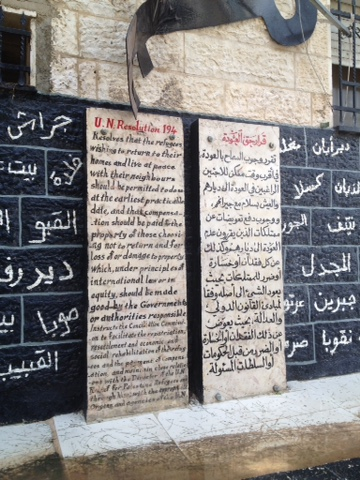
However, the most interesting part of the day for me was our visit to a refugee camp, next door to the cultural centre in which we did our presentation, and home to some of the volunteers to whom we presented. Established in 1949, it then had 3400 inhabitants and was essentially a large field of tents. We tend to think of refugee camps as temporary establishments, especially when it has been reaffirmed and reaffirmed by the UN that refugees have the ‘Right to Return’ and should not have to suffer the trauma of displacement for any extended amount of time. However, 1949-2015-an unspecified date in the future is hardly a temporary establishment. Now the population is an estimated 15,000 and though the tents may have gone, replaced with buildings slowly erected by the refugees themselves, the living conditions are still appalling. Our guide, a soft-spoken but strong-willed resident, reeled off countless shocking examples of the reality of life as a displaced refugee. 

We heard about families living two to a tiny apartment;   whole school year groups crowding around one textbook; losing electricity every other minute; having water running through the streets permanently all year round due to poor plumbing; the lack of sewage facilities;  how the whole camp fails to get a full night’s sleep most nights of the week as soldiers come through with tear gas; children being arrested; and, of course, the fact that every family’s most precious possession is not considered to be their jewellery or their family photos, but rather the key to their house that they had to leave in 1949. It’s awful to think that after all that time, and since the establishment of the UN – who, through UNRWA are meant to provide essential humanitarian aid and support to such marginalised and suffering people - so many can still be living in such squalor. The camp we visited is only one amongst a total of 58 camps in the West Bank, Gaza, East Jerusalem, Jordan, Lebanon and Syria. To imagine the camp that we saw scaled up across all these other locations presents a beyond shocking picture of the Palestinian refugee situation.

 So, I feel immensely privileged to have had the opportunity to view a side of Palestine that is known about but often forgotten, due to the fact that it is often considered ‘old news’ – the plight of millions of Palestinians cannot and should not be considered old news as it recurs every day, day in, day out. We were touched that they appreciated our visit and that our presentation was thought provoking and, as Jumana put it, able to ‘strengthen Palestine from the inside’ by empowering through education and awareness. It was so successful that we shall be returning in the next few weeks to build our presentation into other areas of women’s issues and rights.


Thursday, April 23, 2015

Reflections on the first few weeks

The most startling thing about our first week and a half has been seeing the normality with which people continue their lives despite the daily struggles. Our cohort were all very aware of the exaggerated stereotypes of the dangers of Palestine in the media (especially the common fallacy that West Bank was engulfed by terrorism and violence): At our first team induction in the Sharek Youth Forum building, our Palestinian ‘In-country Volunteers’ (ICVs) clearly found our lack of any glaring false preconceptions about their country quite anticlimactic.

However, no amount of prior reading and understanding could prepare us for the total resilience with which the people of the West Bank continue their lives, while fighting the injustices they face. Following our first conversations each other’s hobbies, studies, interests and social lives, our Palestinian colleagues soon talked frankly about these daily struggles including mistreatment at checkpoints and restrictions on travel. We could offer no conversation in return except understanding and shared indignation. My home country of Scotland, they were told that afternoon, had previously held a democratic independence referendum. Sitting in Ramallah, having passed through Qalandia checkpoint and into the Occupied Territories for the first time, the irony and the dissimilarity between our situations was startling.

Yet, later that week, while exploring the bustling streets – filled with Western brands, shisha bars, and shawarma restaurants – we continually saw a way of life so normal and relatable. The lives of all Palestinians in the West Bank were framed by injustice, but in no way does this impede the vibrancy and friendliness of the region.
Palestinian Olive Trees

It was in this context, that we have begun at our work at the Palestinian Farmers' Union. From its small office in Ramallah, the PFU fights to protect farmers from across the West Bank and Gaza from economic iniquity, protect them from natural crises, and uphold their rights in the face of their unique political situation. Their concerns with issues of land rights, water supplies, and trade restrictions hit at the heart of Palestine’s current plight. After a brief introduction to the offices, we travelled to Bil’in were we saw the effects of occupation first-hand. Our guide showed us hillsides which once contained scores of near-pre-historic olive trees, now dissected by the Wall and the Israeli settlement of Modi'in Illit, barren of trees. In this field, we were told, his cousin had died protesting against these threats to the livelihood of their village.
Bil'In


Our work here would develop over the coming weeks; preparing briefings and proposals to various NGOs and donors, building the PFU’s communications with high-profile individuals and growing the PFU’s social media presence. Yet after just a few days it was already immediately clear to both me and Ben, as it was to our ICV Beesan and all those we were working with, just how crucial this work is in protecting the rights of the people who rely on this land and who for generations have strived to protect it.